Named case shortlist
Four cases for four different constraints
Confirm current specifications, bike compatibility and airline limits before buying.
Scicon Aerocomfort 3.0 Road ↗
The default comparison for frequent road or gravel travel when retaining the handlebar and seatpost position matters. Published weight is about 9.5 kg.
Check the Scicon caseThule RoundTrip Road ↗
Compare when an integrated assembly stand and more compact storage at home or at the destination justify additional disassembly.
Check the Thule Road caseThule RoundTrip Transition ↗
The hard-shell benchmark when impact protection ranks above weight, vehicle capacity and compact storage.
Check the Transition caseEVOC Bike Bag Pro ↗
The current all-round model lists an 8.7 kg weight, 147 × 85 × 36 cm dimensions and a maximum 130 cm wheelbase. Confirm the exact bicycle and current availability.
Check the EVOC caseProvider pages checked 15 September 2026. Confirm the exact current service, specification, price and terms before paying.
Detailed planningRead the full guide+
A buying framework for choosing the right type of case before comparing specific products.
THE DECISION
The best travel case is not automatically the strongest, lightest or most expensive. It is the case that provides an appropriate protection system for your bicycle while remaining workable across airline limits, disassembly, ground transport and storage.
HARD CASE
Strength: rigid external shell and strong resistance to some external impacts.
Trade-offs: usually heavier, bulkier and less forgiving in cars, hotel rooms and storage.
Consider one when external shell protection is a priority, the transfer chain is simple and known, and the weight/storage penalty is acceptable.
SOFT OR SEMI-RIGID BAG
Strength: often lower weight, easier handling and a more manageable storage/vehicle footprint.
Trade-offs: protection depends heavily on the internal support/retention design and correct packing.
Consider one when you travel more frequently, use mixed rail/car transfers or place a premium on easier movement and storage.
OTHER / OCCASIONAL-TRAVEL PACKAGING
Lower-cost or less permanent packaging can suit some occasional trips, but weather resistance, repeatability, protection, handling and sourcing replacement packaging for the return all need consideration. Do not treat low purchase price as the whole cost.
THE EIGHT THINGS TO COMPARE
1. Compatibility with your exact bicycle and the case manufacturer’s supported packing method.
2. Empty case weight and likely finished packed weight.
3. External packed dimensions.
4. Required disassembly and whether you are comfortable performing it correctly.
5. Internal frame/component retention and protection design.
6. Wheel/rotor/hub protection and separation.
7. Wheels/handles and real-world manoeuvrability beyond smooth airport floors.
8. Ground-transport and accommodation storage footprint.
AIRLINE FIT
Use Flying With a Bike — What to Check Before You Book for the current airline-policy process. Do not choose a case based on an assumed universal airline size/weight rule; check the actual itinerary.
PACKING METHOD
Use The Packing System for the universal packing workflow. This buying guide should not become a product-specific mechanical disassembly tutorial.
GROUND TRANSPORT
Use How to Get a Bike Box From the Airport to Your Hotel for the universal transfer framework. A case that saves weight but creates an impossible transfer is not a good travel system.
FREQUENT-TRAVEL LENS
For repeated trips, give more weight to durability of wheels/handles/latches, repeatable packing, manageable empty-case storage, ease of moving through stations/hotels and the cumulative cost of overweight or larger-vehicle requirements.
THE FALSE ECONOMY
A cheaper case can cost more over time if it routinely triggers weight charges, forces larger transfers, is difficult to store or requires a packing process you cannot execute reliably. Conversely, maximum shell protection can be unnecessary if the case makes every other leg of the journey substantially worse.
THE DECISION CHECK
OUR RECOMMENDED TRAVEL CASE SHORTLIST
PEDAL ELSEWHERE DEFAULT FOR A FREQUENT ROAD/GRAVEL TRAVELLER: SCICON AEROCOMFORT 3.0 ROAD
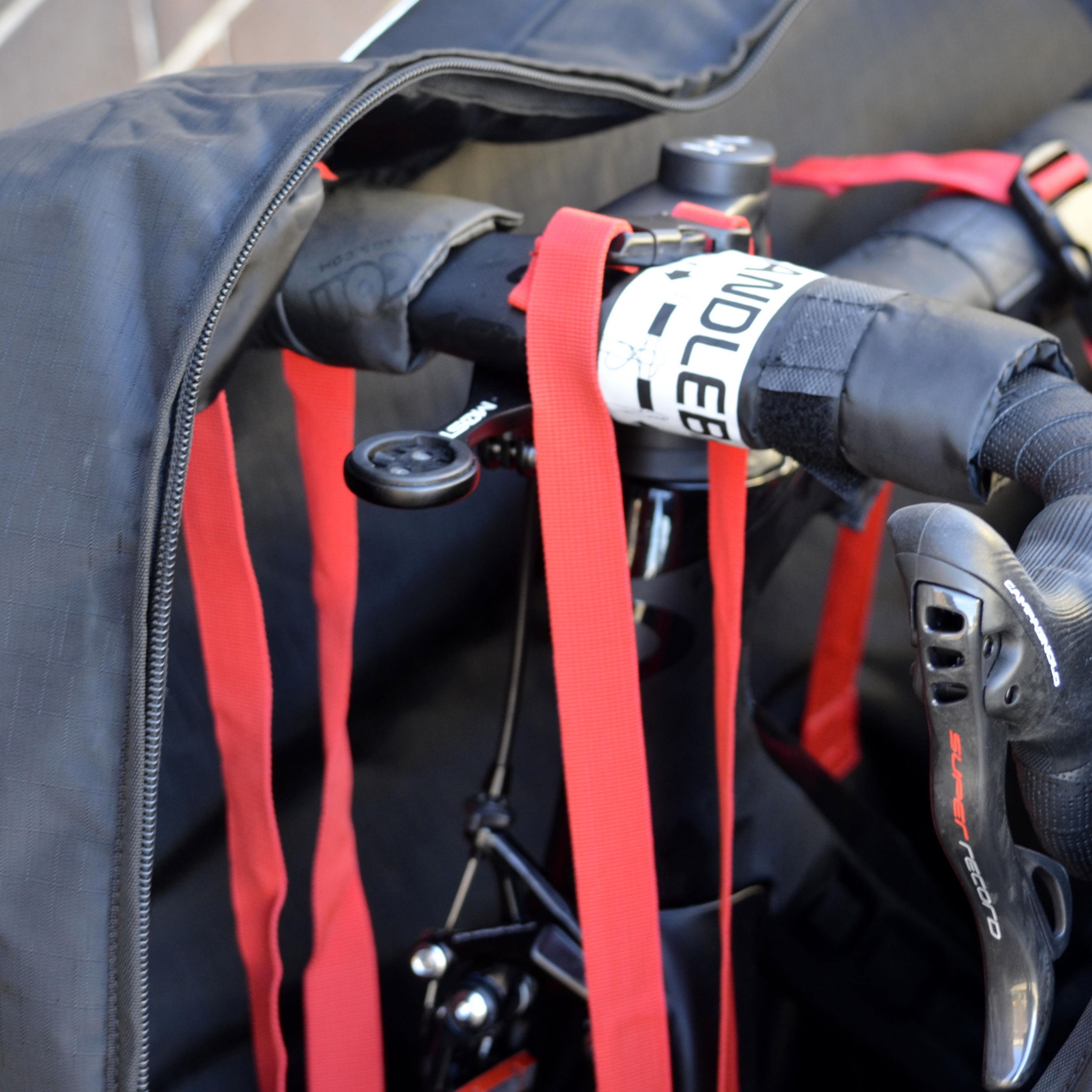
Why it makes the shortlist: Scicon’s current official specification lists the Aerocomfort 3.0 Road at 9.5 kg, designed for road and gravel bikes, with no need to remove handlebars, saddle or seatpost; it uses internal wheel pockets, eight 360-degree wheels and a foldable padded structure. That combination directly addresses our frequent-travel criteria: lower disassembly burden, manageable empty-case weight and easier movement/storage than many rigid cases.
Best fit: road/gravel rider who flies repeatedly and values lower disassembly and easier airport/hotel handling.
Watch-outs: compatibility with the exact bike/cockpit must be confirmed; soft/semi-rigid protection relies on correct internal retention/packing; external dimensions still need checking against the actual airline and ground-transfer chain.
PEDAL ELSEWHERE DEFAULT WHEN INTEGRATED WORK-STAND + COLLAPSIBLE STORAGE MATTER: THULE ROUNDTRIP ROAD
Why it makes the shortlist: Thule currently lists the RoundTrip Road at 27.63 lb (about 12.5 kg), fitting road/gravel/cyclocross bikes up to a 110 cm wheelbase. It includes an integrated work stand, rigid side panels, rotor pockets and collapses to a much smaller storage footprint (124 x 38 x 24 cm) at destination/home. That is a strong travel-system proposition for riders who want more structure than a soft bag without living with a full hard-shell footprint all week.
Best fit: traveller who values a more structured case, integrated assembly stand and compact destination storage.
Watch-outs: heavier than the Scicon; confirm the exact bicycle/wheelbase and airline packed limits; the case still needs a vehicle/storage plan.
HARD-SHELL BENCHMARK: THULE ROUNDTRIP TRANSITION
Thule’s current hard-shell Transition is substantially heavier at 39 lb and is built around an ABS shell and integrated bike stand. It belongs here as the high-protection benchmark, not automatically as the “best” case. Recommend it when shell protection clearly outweighs the airline-weight, vehicle and hotel-storage penalties.
EVOC BIKE BAG PRO — LARGE-BIKE / VERSATILITY COMPARISON
EVOC’s current Bike Bag Pro platform remains a useful comparison for riders who need a larger all-round bike bag; its current fit guidance lists a maximum wheelbase of 130 cm and external dimensions around 147 x 36 x 85 cm for the Bike Bag Pro. Treat it as a compatibility/versatility candidate rather than assuming the larger footprint suits road-travel logistics better.
OUR READER SHORTCUT
Frequent road/gravel flying + minimise disassembly → start with Scicon Aerocomfort 3.0 Road.
Want more structured protection + built-in work stand + collapsible storage → compare Thule RoundTrip Road.
Maximum rigid-shell priority and weight/storage are acceptable → compare Thule RoundTrip Transition.
Large/varied bike compatibility is the primary issue → include EVOC Bike Bag Pro in the comparison.