The organising rule
Schedule effort types, not fixed passes
Feature climb
Move the priority objective to the best current weather and access window.
Recovery
Use a short easy spin, a full rest day or a non-riding local day.
Weather buffer
Keep a lower, shorter or less exposed option ready when high passes are unsuitable.
The week at a glance
A mountain week with recovery built in
Arrive
Complete the transfer, set up the bike and stop before a headline climb.
Orient
Learn the gradients, descents, temperature changes and how the gearing feels.
Feature one
Use the first strong window for a validated major mountain objective.
Recover
Ride easily, rest completely or spend a day away from the bike.
Feature two
Choose from current access, forecast and accumulated fatigue.
Change pace
Use a lower or less exposed ride as both variety and weather buffer.
Flex
Take a final feature only when the body, conditions and departure allow it.
Depart
Return or repack the bike with margin for the mountain transfer.
Detailed planningRead the full guide+
WHO THIS IS FOR
This framework is for a competent recreational road cyclist who wants a first dedicated high-mountain week. It assumes sustained climbing and descending are central to the trip, but that recovery, weather and gearing deserve as much planning as the headline climbs.
It is not a turn-by-turn route plan. High-pass access, weather, road conditions and route metrics require current validation. No pass is guaranteed rideable because it appears on this itinerary.
WHY BORMIO FOR THIS VERSION
The launch version uses Bormio / Alta Valtellina because it allows a coherent single-base mountain week around several major climbing objectives. The Dolomites should have its own itinerary once Pedal Elsewhere can support that collection to equal depth.
Use Bormio vs the Dolomites before choosing the region.
DAY 1 — ARRIVAL AND MOUNTAIN-TRIP SETUP
The airport-to-base journey is substantial enough to count as part of the day. Do not schedule a headline climb after arrival.
Bring-your-own: complete the transfer, assemble according to applicable instructions, perform the Post-Flight Bike Check and use only a short low-risk shakedown if everything is satisfactory.
Rental: confirm fit, gearing, brakes, controls and a short shakedown. In the Alps, a wrong lowest gear is not a minor inconvenience.
DAY 2 — LOWER-RISK ORIENTATION RIDE
Use a moderate ride to understand local gradients, temperature changes, descending, traffic and how your gearing feels. Keep substantial margin.
The objective is information, not a summit. If the gearing feels marginal now, solve it before the hardest day.
DAY 3 — FIRST MAJOR MOUNTAIN OBJECTIVE
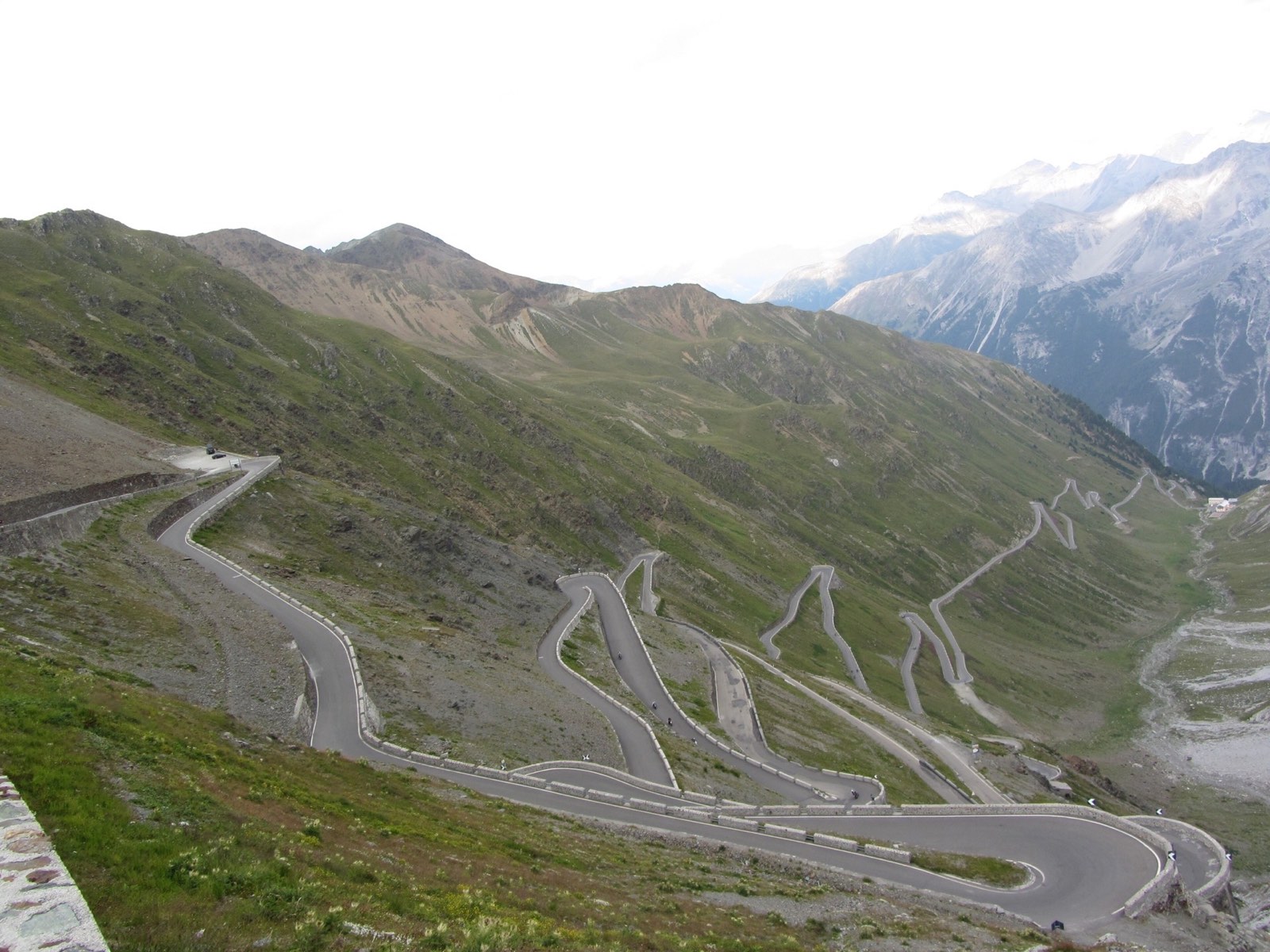
Move the best available major objective into the best current weather and access window. Stelvio can be one candidate for a Bormio-led week, but only after current status and conditions are confirmed.
Harder version: complete the full planned objective when conditions, fitness and recovery support it.
Easier version: choose a shorter or lower-altitude climbing day if the weather or body says no.
Plan this day from current official pass, road and weather information rather than assuming a named climb will be available.
DAY 4 — RECOVERY / RIDE BEFORE LUNCH
A first Alpine week improves when the rider stops trying to prove something every day.
Option A: short easy spin at lower intensity.
Option B: full rest day.
Option C: non-riding local day.
Use the time to check the bike, clothing, forecast and how the body is responding. Do not automatically fill the day with another pass because the sun is out; preserve flexibility for the second half of the week.
DAY 5 — SECOND FEATURE WINDOW
Choose the objective based on current pass status, forecast and accumulated fatigue. Gavia or another significant climb can be considered for a Bormio-led week, subject to current conditions.
Do not stack objectives simply because they are geographically close. Long descents, altitude and repeated climbing can make a nominally manageable day much harder.
DAY 6 — VARIETY / LOWER-ALTITUDE DAY
Deliberately change the stimulus. Choose a lower-altitude, shorter or less exposed ride rather than another maximal pass day.
This day is also the weather buffer: if an earlier major objective was postponed, it can become the replacement window only when conditions support it.
DAY 7 — FINAL FEATURE OR BEST-OF-WEEK FLEX
If recovery and conditions are excellent, use the final strong window for the remaining priority objective. If not, choose an enjoyable shorter ride and finish the week wanting another Alpine trip.
Do not schedule the hardest possible ride so late that repacking, recovery or the departure transfer becomes unsafe or rushed.
DAY 8 — DEPARTURE
Bring-your-own: repack using the same Packing System, protect enough time for the mountain-to-airport transfer and account for current airline bicycle handling.
Rental: return with sufficient margin and confirm any handover requirements before starting the airport journey.
THE WEEK AT A GLANCE
Day 1 — arrival and setup.
Day 2 — orientation.
Day 3 — major mountain window 1.
Day 4 — recovery.
Day 5 — major mountain window 2.
Day 6 — variety and weather buffer.
Day 7 — final feature or flex.
Day 8 — departure.
THE ALPINE WEATHER RULE
The days describe effort types, not fixed passes. Move high and exposed objectives to the safest appropriate weather window. If access or conditions are poor, use lower-altitude riding or rest. Summit ambition does not override road closures, deteriorating weather or safety concerns.
GEARING IS PART OF THE ITINERARY
Choose gearing before the trip for sustainable climbing after several hours and several days, not for a fresh rider on one gradient. If renting, confirm the actual lowest gear rather than accepting a generic “climbing bike” description.
BRING OR RENT?
A single-base Alpine week strengthens the case for bringing your own bike because fit, braking and handling familiarity and known gearing matter on long climbs and descents. Rental remains credible when the supplier can confirm a genuinely appropriate setup and avoiding the case materially simplifies the airport-to-mountain journey.
WHAT TO PACK DIFFERENTLY
High mountains create a different clothing problem from the valley. Long descents and rapid weather changes require deliberate, modular layering. Use the Pedal Elsewhere Packing System to keep that kit organised without turning the case into an everything-you-own checklist.
WHAT TO BOOK FIRST
1. Choose Bormio / Alta Valtellina or another coherent Alpine region.
2. Choose accommodation and base for ride access.
3. Decide bring versus rent and confirm gearing.
4. Model the airport-to-mountain journey with the actual case if bringing.
5. Build the week around flexible effort types.
6. Confirm final pass access, forecast and route conditions close to each ride.
WHAT THIS ITINERARY DOES NOT CLAIM
It does not claim first-hand riding, current pass opening, hotel inspection or supplier testing. Named climbs are candidate objectives, not guarantees. Exact route, elevation, surface, access and hazard information requires current validation both while planning and close to the ride.
Check before you ride
Current official sources
Conditions and access can change. Use these live sources when turning the framework into an actual ride plan.
Check which major passes are open before choosing a high-mountain objective or transfer route.
↗Bormio · Current road conditionsReview updated road information around Bormio and Alta Valtellina before setting the day’s route.
↗ARPA Lombardia · Official weather outlookUse the regional forecast as one input, then check conditions for the exact elevation and exposure close to the ride.
↗Bormio · Official road-cycling overviewDestination context for Bormio’s major passes and lower-profile climbs; route suitability still requires a current check.
↗